
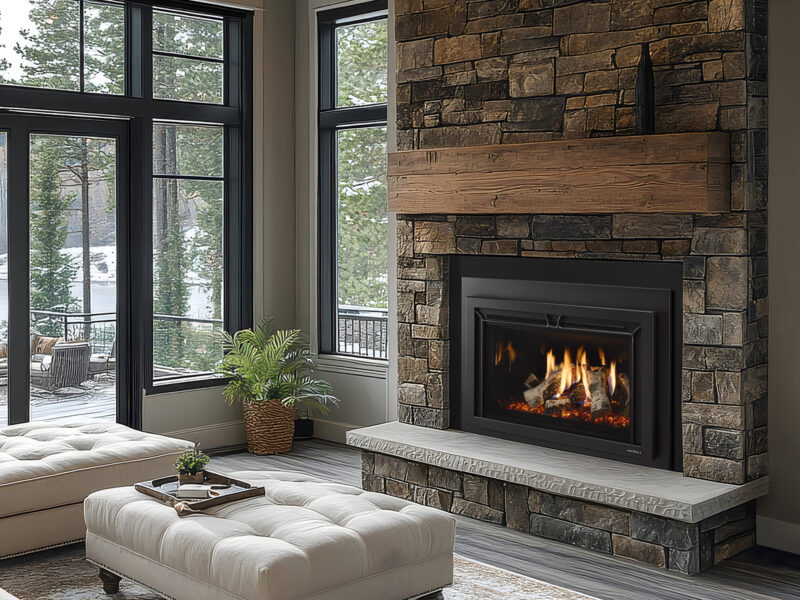
The cozy upgrade your living room is missing…
There’s a particular kind of quiet that settles into a home once the fire is lit. The room dims to amber. Voices drop half a notch. Someone pulls a blanket over their knees without even thinking about it. This is the moment a fireplace exists for — and it’s also the moment many older masonry fireplaces quietly waste.
If you’ve ever sat close to a roaring fire and still felt a draft at your back, you already know the problem. The fix has a name, and it’s simpler than most people expect: a fireplace insert.
What Is a Fireplace Insert?
A fireplace insert is a self-contained heating unit that slides directly into an existing, often underperforming, masonry fireplace. Instead of building a fire in an open hearth — where most of the heat rises straight up the chimney — an insert seals the firebox and is designed to push warm air back out into the room.
In short: a fireplace insert turns a decorative, heat-losing fireplace into an efficient, everyday heat source, without requiring you to tear out your existing mantel or hearth.
Inserts come in three main types:
- Gas inserts — instant flame, no wood to haul or ash to sweep, controlled with a switch or remote
- Wood-burning inserts — for people who love the ritual of a real wood fire, but want far more heat and far less smoke
- Electric inserts — flame effect and warmth with the simplest install, no venting required
Each one is built to do the same essential job: keep the warmth where you and your family actually are.
Why Older Open Fireplaces Struggle to Keep You Warm
Traditional open fireplaces are wonderful for atmosphere but can sometimes be inefficient for heat. Because the firebox is open to the room and vented straight up the chimney, a significant portion of the warm air a fire generates escapes before it ever reaches your couch. Worse, an open fireplace can actually pull heated air from the rest of your house up the flue, working against your furnace rather than with it.
A fireplace insert solves this by enclosing the fire and using a sealed system — often with a blower — to circulate warm air outward into the room instead of upward and out. The result is a fireplace that finally does what it always promised to: heat the space you’re sitting in.
The Case for Making the Switch
More warmth, less waste. Inserts are built for efficiency, meaning more of the heat you’re generating ends up warming your living room instead of the night sky.
Everyday convenience. Many gas and electric inserts turn on with the flip of a switch or the press of a button — no kindling, no waiting, no midweek trip for firewood.
A safer, more contained fire. Sealed fireboxes and glass fronts help contain sparks and embers, which matters most in homes with kids, pets, or curious guests.
A longer fireside season. Because inserts heat so effectively, many households find they use their fireplace more often — not just on special occasions, but on ordinary Tuesday nights.
A refreshed look, without a renovation. An insert slides into your current firebox, so you keep your mantel, your stonework, your character — just with a fire that actually performs.
Where the Moments Happen
There’s a reason people gather near a fire even when the room has central heat. It’s not only about temperature. It’s the chairs pulled a little closer, the bowl of something warm on the coffee table, the way autumn light through the window pairs with a low, steady flame. A fireplace insert doesn’t just make that scene warmer — it makes it easier to have more often, with less effort and less worry about where all that heat is actually going.
Frequently Asked Questions
Does a fireplace insert fit any existing fireplace? Most masonry and prefabricated fireplaces can accommodate an insert, though sizing and venting requirements vary. A quick measurement of your firebox is the best starting point.
Are fireplace inserts worth it? For most homeowners, yes — inserts significantly improve heating efficiency compared to an open fireplace, and many households see a noticeable difference in comfort and, often, energy costs.
What’s the difference between a fireplace insert and a stove? An insert is designed to fit inside an existing fireplace opening, while a stove is a freestanding unit. If you already have a fireplace, an insert is typically the more seamless upgrade.
Can I still see the flames with an insert? Yes. Nearly all inserts are designed with a glass front specifically so you keep the visual warmth of a real fire while gaining the sealed efficiency behind it.
Curious which type of insert fits your fireplace, your home, and the way you actually like to spend an evening? Visit one of our showrooms to learn more about gas, electric, and wood-burning inserts in person — and start planning the kind of cozy night that’s easy to come back to.